Focus on the dependencies that need attention
Prioritized dependency findings help you focus on what to fix first. When a fix is available, Lumstep can automatically open a pull request.
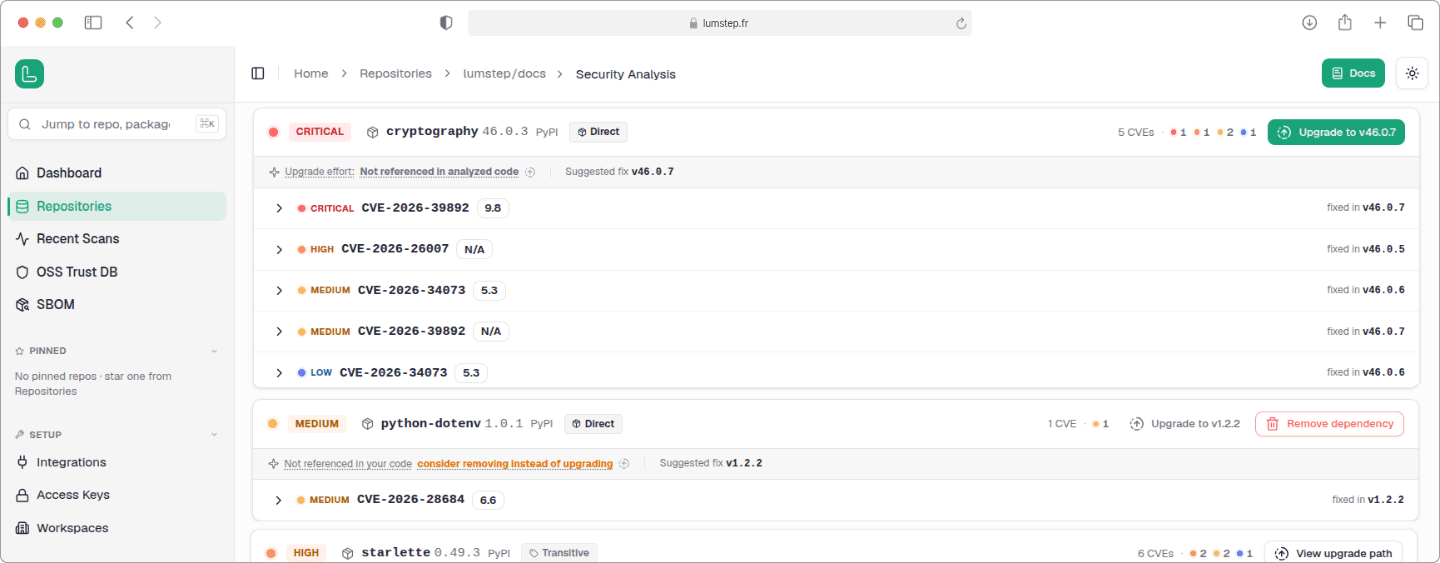
Every package, top to bottom
Lumstep analyzes your software inventory to identify vulnerable and unused dependencies. Every scan covers the packages your project uses, including those brought in automatically by other dependencies.
The risks that actually matter, first
Multiple risk signals, including vulnerability reachability, are combined to prioritize dependency issues and help distinguish high-priority findings from lower-risk ones.
The fix, opened for you
Available dependency updates and unused dependency removals can be delivered as ready-to-review pull requests. Your team decides what to merge.
Support for the languages and ecosystems your projects rely on
npm, pip, Maven, Go, Cargo, NuGet, and RubyGems are all covered. One scan spans your whole stack.
FAQ about dependency scanning
What is software composition analysis (SCA), and why does it matter?
Software composition analysis checks every open source package your project depends on against known-vulnerabilities. It matters because most of a modern application is code your team didn't write: you inherit the vulnerabilities of every package you pull in, including the ones you never chose directly. Lumstep runs SCA on every scan and, where a safe upgrade exists, opens the pull request for you.
There's a vulnerability in a package I've never heard of. How did it get into my project?
Most packages in a project arrive indirectly - pulled in by something else you installed - and a vulnerability in one of those is just as exploitable as one in a package you picked and puts you at risk. Lumstep scans the full tree, direct and transitive, and shows which of your dependencies pulled the vulnerable package in.
Which package ecosystems does Lumstep support?
npm, pip, Maven, Go, Cargo, NuGet, and RubyGems are all covered, spanning JavaScript, Python, Java, Kotlin, Go, Rust, .NET, and Ruby projects in a single scan.
How does Lumstep decide which vulnerabilities to prioritize?
Multiple risk signals are combined, including whether a vulnerability is actively exploited, whether it's reachable in your code, and whether the package is used directly or buried deep in the tree. That combined score, not just CVE severity, determines what's ranked as urgent.
What happens when Lumstep finds a fixable vulnerability?
Where a fix is available, Lumstep can automatically open a ready-to-review pull request bumping the dependency to a safe version. Your team decides what to merge. Unused dependencies are flagged for removal the same way.
How is Lumstep different from Snyk or Dependabot?
Dependabot does one job well: opening pull requests to keep your dependencies up to date. Snyk is the closer comparison - it scans dependencies, code, and secrets too. Lumstep differs in triage: findings are ranked by whether a vulnerability is being exploited and whether your code actually reaches the affected package, so unreachable findings and unused dependencies fall down the list instead of competing for attention.
Is it safe to give Lumstep access to my code and dependency manifests?
Yes. Scans run in isolated, per-tenant sandboxes, your data is encrypted with keys unique to your organization, and nothing is shared across customers.
See which of your dependencies are at risk.
Free early access. Automatic fix PRs available from your first scan.